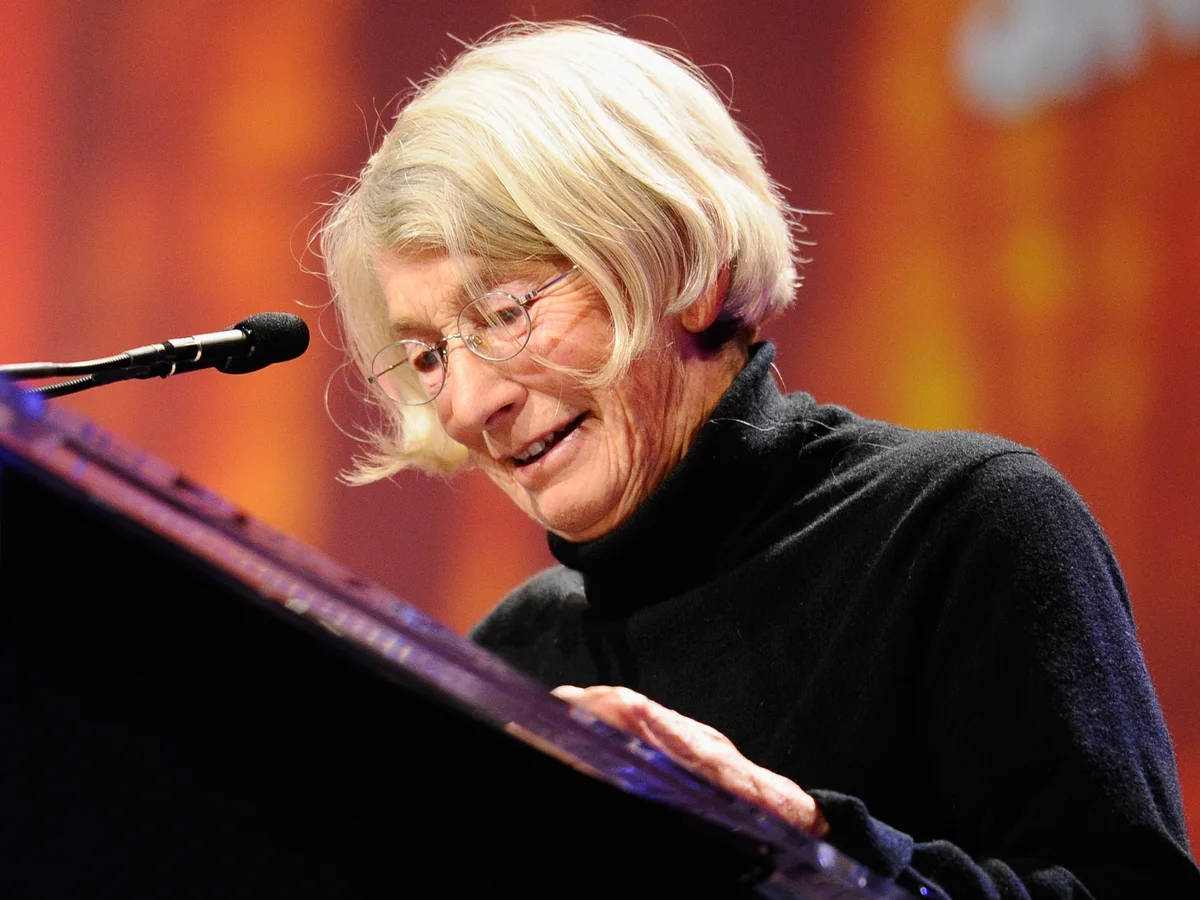
Mary Oliver Biography
Mary Jane Oliver was an American poet whose clear, attentive verse brought the natural world into the daily lives of countless readers. Born in a quiet Ohio suburb and shaped by long walks through woods and along shores, she built a body of work that invited people to notice the ordinary miracles around them. Her poems speak in plain language yet carry deep feeling for the living earth, for solitude, and for the quiet work of paying attention.
Over more than five decades she published more than fifteen collections of poetry and several volumes of prose, earning the Pulitzer Prize and the National Book Award along the way. Readers found in her writing a steady companion who asked simple, lasting questions about how to live. This biography traces her path from a difficult childhood in the Midwest to a life rooted in Cape Cod landscapes and, finally, to Florida, always returning to the sources that fed her art.
Mary Oliver Early Life
Mary Jane Oliver was born on September 10, 1935, in Maple Heights, Ohio, a semi-rural suburb on the outskirts of Cleveland. Her parents were Edward William Oliver, a social studies teacher and athletics coach in the Cleveland public schools, and Helen M. Vlasak Oliver, whose family had roots in Bohemian farming communities that settled in Ohio. The household was marked by strain. Oliver later described her family as very dysfunctional and her childhood as hard. She spoke of seeking escape from a dark and broken house, finding refuge in the nearby woods and fields.
In those woods she built small shelters of sticks and grass and began to write. Nature offered the first real sense of connection she felt, more reliable than the social world inside the home. She started writing poetry at age fourteen. By fifteen she had already formed a strong desire to become a writer. In the summer of 1951 she attended the National Music Camp at Interlochen, Michigan, where she played percussion in the National High School Orchestra. Music remained a quieter part of her early formation, yet the discipline of attention it required would later appear in her careful observation of the natural world.
After graduating from the local high school in Maple Heights, Oliver left Ohio the morning after commencement. She had been corresponding with Norma Millay Ellis, sister of the late poet Edna St. Vincent Millay. Oliver traveled to Steepletop, the Millay estate in Austerlitz, New York. She stayed for several years, living in the house and helping Norma organize the papers Edna had left behind. The experience placed her inside the daily atmosphere of a major American poet’s life and work. During these years she also attended classes at Ohio State University in Columbus and later at Vassar College in Poughkeepsie, New York, following in a limited way the educational path of Millay herself. She did not complete a degree at either school. Formal education never became central to her development; the woods, the Millay papers, and her own steady reading and writing mattered more.
Maple Heights and the wider Ohio landscape of her youth remained present in her early poems. The semi-rural setting, with its mix of open land and approaching suburban growth, gave her a first map of the natural world that she would later expand on Cape Cod. The difficulties of home life pushed her outward toward fields, trees, and solitude, habits that lasted a lifetime.
Mary Oliver Career
Oliver’s publishing career began in the early 1960s and continued with steady productivity for more than fifty years. Her first collection, No Voyage and Other Poems, appeared in 1963 in England and was reissued in the United States in 1965 by Houghton Mifflin. The book showed early influence from Millay in its lyric quality and attention to place, including scenes drawn from Ohio. Subsequent volumes arrived at a measured pace. The River Styx, Ohio, and Other Poems came out in 1972, followed by Twelve Moons in 1978 and The Night Traveler the same year. These early books established her voice as one rooted in the physical world and in careful, unadorned speech.
Mary Oliver Early Publications and Growing Recognition
Recognition grew gradually. Oliver received the Poetry Society of America’s first prize in 1962 for the title poem of her first book, the Shelley Memorial Award in 1970, and the Alice Fay di Castagnola Award in 1973. A National Endowment for the Arts fellowship supported her work in the early 1970s. She also held teaching and administrative roles that kept her connected to other writers. She served as chair of the writing department at the Fine Arts Work Center in Provincetown, Massachusetts, in 1972–73 and remained involved with the center later.
Mary Oliver Pulitzer Prize and National Recognition
The turning point arrived with American Primitive, published by Little, Brown in 1983. The collection of fifty poems focused on the renewals of nature and the physical world with unusual intensity. In 1984 it received the Pulitzer Prize for Poetry. Critics noted its insistence on the primacy of the physical and its distinctive voice. The prize brought wider attention when Oliver was nearly fifty years old. She followed it with Dream Work in 1986, a volume that continued the exploration of nature while turning more directly toward questions of the self and suffering.
House of Light, published by Beacon Press in 1990, earned both the Christopher Award and the L. L. Winship/PEN New England Award. Two years later New and Selected Poems, Volume One (Beacon Press, 1992) won the National Book Award for Poetry. The volume gathered work from across her career and introduced many new readers to poems that had already begun to circulate widely, among them “Wild Geese” and “The Journey.” Later collections included White Pine (1994), West Wind (1997), The Leaf and the Cloud (2000), a book-length poem, Why I Wake Early (2004), Thirst (2006), Red Bird (2008), Swan (2010), A Thousand Mornings (2012), Dog Songs (2013), Blue Horses (2014), and Felicity (2015). A career-spanning selection, Devotions, appeared in 2017.
Oliver also wrote prose that examined the craft of poetry and the relation between self and landscape. A Poetry Handbook (1994) and Rules for the Dance (1998) remain practical guides used in writing programs. Essay collections such as Blue Pastures (1995), Winter Hours (1999), Long Life (2004), and Upstream (2016) offered further reflections on attention, nature, and the writing life. She edited The Best American Essays in 2009.
Mary Oliver Teaching and Residencies
Teaching formed another part of her professional life. She served as Mather Visiting Professor at Case Western Reserve University, poet-in-residence at Bucknell University, Elliston Visiting Professor at the University of Cincinnati, and Margaret Banister Writer-in-Residence at Sweet Briar College. From the mid-1990s until 2001 she held the Catharine Osgood Foster Chair for Distinguished Teaching at Bennington College. Honorary doctorates later came from the Art Institute of Boston, Dartmouth College, and Tufts University.
Throughout these years Oliver maintained a private, almost elusive public presence. She gave few interviews, preferring that the poems themselves carry the conversation. By the early twenty-first century The New York Times described her as far and away the country’s best-selling poet. Her work reached readers far beyond academic circles, appearing in magazines, on posters, and in personal collections of meaningful lines.
Mary Oliver Literary Style and Themes
Oliver’s poems are marked by clear, accessible language and vivid yet unforced imagery drawn from the natural world. She rejected fancy diction, believing poetry must not be ornamental. Daily walks supplied the material: birds, ponds, foxes, geese, grasses, the changing light of morning and evening. The poems often begin in close observation and open outward into questions of attention, mortality, gratitude, and the possibility of wonder.
Recurring themes include the healing or restorative power of solitude in nature, the connection between the human spirit and the living earth, and the quiet insistence that ordinary experience holds sufficient depth. Poems such as “Wild Geese,” “The Summer Day,” and “When Death Comes” became especially widely known for their direct address and memorable closing questions or statements. Critics sometimes placed her in a Romantic or Transcendental lineage that includes Thoreau, Emerson, and Whitman, while noting her own distinctive plainness of speech. Some academic readers found the work too accessible or too focused on beauty and nature; popular readers found in it a reliable source of clarity and consolation. Both responses speak to the same quality: the poems refuse to hide behind specialized language.
Mary Oliver Major Works and Influence
Beyond the prize-winning volumes, certain books and individual poems have continued to shape how new generations encounter her. American Primitive remains central for its intense physicality. House of Light explores solitude and light. New and Selected Poems serves as an entry point for many. Later books such as Dog Songs and Felicity show a late style that is still attentive yet often lighter in tone. The prose handbooks continue to be assigned in classrooms because they treat meter, sound, and the habits of observation with practical care.
Her influence appears in the work of younger poets who value clarity and ecological attention, and in the broader culture where lines from her poems circulate as personal reminders to stay present. The reach of her work across both literary and general audiences is unusual among contemporary American poets.
Mary Oliver Awards
Oliver’s major honors include the Pulitzer Prize for Poetry in 1984 for American Primitive, the National Book Award for Poetry in 1992 for New and Selected Poems, the Poetry Society of America’s Shelley Memorial Award, the Alice Fay di Castagnola Award, fellowships from the Guggenheim Foundation and the National Endowment for the Arts, the American Academy and Institute of Arts and Letters Achievement Award, the Christopher Award and the L. L. Winship/PEN New England Award for House of Light, the Lannan Literary Award, and the New England Booksellers Association Award for Literary Excellence. These recognitions arrived across decades and confirmed the steady quality of a long career rather than a single sudden success.
Mary Oliver Personal Life
Oliver met the photographer Molly Malone Cook in the late 1950s at Steepletop. Cook became her partner for more than forty years. Oliver later wrote that she took one look and fell, hook and tumble. Cook worked as a photographer, gallery owner, and eventually as Oliver’s literary agent. The two made their home largely in Provincetown, Massachusetts, on the tip of Cape Cod. The town’s mix of working fishermen, artists, writers, and a long-standing community of people drawn to its relative openness suited them. Oliver fell in love with the convergence of land and water, the Mediterranean light, and the hard practical work of the harbor. The surrounding beaches, ponds, marshes, and woods became the landscape of her mature poetry. Daily walks with notebook in hand supplied the concrete details that filled the poems.
They lived together until Cook’s death in 2005. Afterward Oliver compiled Our World, a volume that paired Cook’s photographs and journal notes with Oliver’s own reflections. The book stands as both tribute and record of a shared life. Following Cook’s death Oliver moved to Hobe Sound, Florida, on the southeastern coast. She continued to write, though the Florida years were quieter and marked by health challenges. In 2012 she was diagnosed with lung cancer and treated successfully. Later she developed lymphoma. She died of lymphoma on January 17, 2019, at her home in Hobe Sound at the age of eighty-three. No immediate family members survived her. Her literary executor confirmed the details of her passing.
Oliver valued privacy highly. She rarely discussed personal matters in interviews and preferred that readers encounter her through the work rather than through biographical detail. The partnership with Cook and the decades in Provincetown remain the central facts of her adult private life, visible mainly in dedications, in the landscapes of the poems, and in the later memoir of their shared world.
Mary Oliver Life in Provincetown and Connection to Place
Provincetown shaped Oliver’s mature voice as thoroughly as the Ohio woods had shaped her beginnings. The town’s position at the end of Cape Cod offered salt air, shifting dunes, tidal flats, and a rich variety of birds and marine life. Oliver walked these places almost every day, often early in the morning. The practice of walking and looking became both method and subject. Many poems record specific encounters: a fox, a pond at dawn, the flight of geese, the sound of water. The poems do not turn these encounters into symbols so much as they stay with the concrete fact and allow meaning to arise from careful attention.
The artistic and somewhat bohemian atmosphere of Provincetown also provided a tolerant setting for the life she shared with Cook. Oliver rarely wrote directly about the town’s social world, yet the freedom to live and work there without constant scrutiny supported the privacy she required. After Cook’s death the move to Florida marked a change of landscape, yet the habits of observation continued. The earlier Cape Cod years remain the richest source for the majority of her best-known work.
Mary Oliver Later Years and Final Works
In the years after the National Book Award, Oliver’s output remained steady. Collections continued to appear at regular intervals, each returning to themes of attention, mortality, and the natural world while registering the changes of advancing age. Thirst and later volumes show a poet still fully engaged with the living world even as the poems sometimes contemplate loss and the approach of death. Devotions, the large selected volume of 2017, offered readers a comprehensive view of the career. Health difficulties in the final decade limited public appearances, yet the writing continued until near the end. Her death in 2019 closed a body of work that had already reached an unusually wide audience for American poetry.
Conclusion
Mary Oliver’s life and work demonstrate the lasting power of close, sustained attention to the ordinary world. From a strained childhood in Maple Heights, Ohio, through years of quiet apprenticeship and then decades of disciplined walking and writing on Cape Cod, she produced poems that many readers keep close for their clarity and their invitation to notice. The major awards confirmed what a large public already felt: her voice offered something rare in its combination of accessibility and depth. The partnership with Molly Malone Cook and the landscapes of Provincetown supplied the conditions in which that voice matured. Her books remain in print and continue to find new readers who discover in them a way of looking that feels both personal and shared. The poems do not demand specialized knowledge; they ask only that the reader look and listen. In that request lies the core of her lasting contribution.
FAQs
Who was Mary Oliver?
Mary Jane Oliver was an American poet born in 1935 in Maple Heights, Ohio, and known for poetry that centers on the natural world, clear language, and questions of attention and living. She won the Pulitzer Prize and the National Book Award and became one of the best-selling poets in the United States.
Where was Mary Oliver born and raised?
She was born and raised in Maple Heights, Ohio, a suburb of Cleveland. The semi-rural setting and nearby woods played a formative role in her early development as a writer.
What are Mary Oliver’s most famous poems?
Among the most widely known are “Wild Geese,” “The Summer Day,” “The Journey,” and “When Death Comes.” These poems are frequently anthologized and quoted for their directness and memorable closing lines.
Did Mary Oliver win major literary awards?
Yes. She received the Pulitzer Prize for Poetry in 1984 for American Primitive and the National Book Award for Poetry in 1992 for New and Selected Poems. She also received fellowships from the Guggenheim Foundation and the National Endowment for the Arts, among other honors.
Who was Mary Oliver’s partner?
Molly Malone Cook, a photographer and gallery owner, was Oliver’s partner for more than forty years. They lived primarily in Provincetown, Massachusetts. Cook also served as Oliver’s literary agent. Cook died in 2005.
Where did Mary Oliver live for most of her adult life?
She lived for more than four decades in Provincetown, Massachusetts, on Cape Cod. After Cook’s death she moved to Hobe Sound, Florida, where she spent her final years.
When and how did Mary Oliver die?
Mary Oliver died on January 17, 2019, at her home in Hobe Sound, Florida, at the age of eighty-three. The cause was lymphoma.
Did Mary Oliver teach?
Yes. She held visiting and residency positions at several colleges and universities and served as the Catharine Osgood Foster Chair for Distinguished Teaching at Bennington College until 2001.
What influenced Mary Oliver’s writing?
Early influence came from Edna St. Vincent Millay, whose papers she helped organize. Broader literary influences include the American nature tradition associated with Thoreau and Emerson. Daily walks in the natural world supplied the concrete material for most of her poems.
Is Mary Oliver still widely read?
Yes. Her books remain in print, and individual poems continue to circulate widely among both literary readers and a general audience. She has been described as one of the country’s best-selling poets.