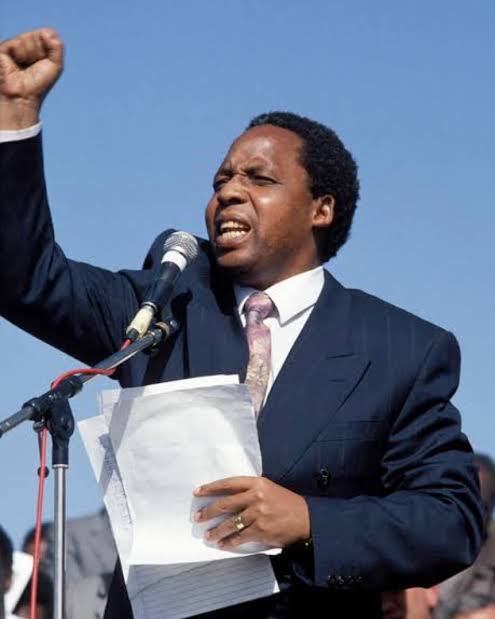
Chris Hani Biography
Chris Hani, born Martin Thembisile Hani, was a South African revolutionary, soldier, and political leader who was born in Sabalele village, Cofimvaba, in the Transkei region of the Eastern Cape, South Africa. He was a South African by nationality and one of the most influential figures in the country’s long struggle against apartheid, a system of racial segregation that denied Black South Africans basic political and civil rights for decades.
Hani rose from a poor rural background to become one of the most recognised and beloved leaders of the liberation movement. He served in senior positions within the African National Congress, Umkhonto we Sizwe, and the South African Communist Party. His life was marked by sacrifice, exile, and unwavering commitment to justice, and his assassination in 1993 remains one of the most significant and painful moments in South Africa’s transition to democracy. This article looks closely at his early years, education, career, personal life, and lasting legacy.
Chris Hani’s Early Life
Chris Hani was born on 28 June 1942 in the small village of Sabalele, near Cofimvaba, in what was then called the Transkei, part of the Eastern Cape province of South Africa. He was the fifth of six children born to Gilbert and Mary Hani. His father, Gilbert, worked as a migrant labourer in the mines and later in construction, and he was also politically active, a background that shaped young Hani’s early awareness of racial injustice.
His mother, Mary, had never attended school, yet both parents placed great value on education as a path to a better life for their children. Life in Sabalele was simple and, at times, difficult. As a boy, Hani walked long distances to attend school, and he quickly showed signs of academic promise, twice completing two school grades within a single year.
At the age of twelve, after listening to his father explain the injustices of apartheid and the work of the African National Congress, Hani expressed a wish to join the movement, though he was still too young to be accepted. He also spent time as an altar server in his church and, for a while, considered becoming a priest, an ambition his father discouraged in favour of a more practical path.
Chris Hani’s State of Origin: The Eastern Cape
Understanding where Chris Hani came from helps explain much about the man he became. He was born and raised in Cofimvaba, a rural town in the Transkei region, which today forms part of the Eastern Cape province of South Africa. The Transkei was one of the areas later designated by the apartheid government as a “homeland” for Xhosa speaking South Africans, a policy designed to strip Black citizens of their South African citizenship and confine them to overcrowded, underdeveloped territories.
Hani was born into a Xhosa family, and Xhosa culture, language, and community life shaped his early identity. The Eastern Cape more broadly has produced many of South Africa’s most important liberation leaders, including Nelson Mandela, Oliver Tambo, and Govan Mbeki, and Hani grew up within this same tradition of political consciousness and resistance. The poverty and limited opportunity he witnessed in Cofimvaba, combined with his father’s own political involvement, gave him a firsthand understanding of the everyday realities of apartheid long before he became a national figure. Even after decades spent in exile across southern Africa and Europe, Hani never lost his connection to his Eastern Cape roots, and the region continues to honour him as one of its most celebrated sons.
Chris Hani’s Education
Hani began his schooling close to home before moving to Lovedale High School, a well regarded missionary institution in the Eastern Cape that had educated many notable African leaders. At Lovedale, he studied English, Xhosa, Latin, history, mathematics, and hygiene, and he developed a genuine love for literature and classical languages. It was also at Lovedale, at around the age of fifteen, that he joined the ANC Youth League, despite the fact that political organising was officially forbidden in Black schools under apartheid law. He encouraged fellow students to become politically active as well.
After matriculating, Hani enrolled at the University of Fort Hare in Alice, Eastern Cape, in 1959. Fort Hare was, at the time, one of the very few universities open to Black South Africans, and it had already produced figures such as Nelson Mandela, Oliver Tambo, and Robert Sobukwe. At Fort Hare, Hani studied English, Latin, and modern and classical literature. He was known to prefer intellectual pursuits over sport, once remarking that he would rather fight apartheid than play sport. It was during his time at Fort Hare that he was introduced to Marxist thought, an encounter that had a lasting influence on his political outlook.
Hani went on to complete his studies at Rhodes University in Grahamstown, where he earned a Bachelor of Arts degree in 1962. After graduation, he briefly worked as an articles clerk at a law firm, preparing for a possible legal career, but his growing commitment to the liberation struggle soon took precedence over that path.
Chris Hani’s Career
Joining the ANC Youth League and the Communist Party
Hani’s political career began formally when he joined the ANC Youth League as a teenager. His involvement deepened after the arrest of ANC leaders during the Treason Trial of the 1950s, an event he later described as a turning point that pushed him further into activism. In 1961, while still a student, Hani joined the South African Communist Party, drawn to its ideas about class, race, and economic justice. He would remain closely tied to the party for the rest of his life.
Umkhonto we Sizwe and Military Training
In 1962, following the formation of Umkhonto we Sizwe, the armed wing of the ANC, Hani became one of its early volunteers. Umkhonto we Sizwe, whose name means “Spear of the Nation,” was formed after the ANC concluded that peaceful protest alone could not defeat the apartheid state. Hani underwent military training, including instruction received in the Soviet Union, and he later fought alongside Zimbabwean nationalist forces against the white minority government of Rhodesia, present day Zimbabwe. His courage and discipline in these campaigns earned him a strong reputation as a capable and fearless commander, even among his opponents.
Arrest, Exile, and Life in Lesotho
In 1962, Hani was arrested for the first of several times under the Suppression of Communism Act, a law used by the apartheid government to criminalise political dissent. After exhausting his legal options, he went into exile with his father in Lesotho in 1963. For several years, Lesotho became his main base of operations. From there, he helped organise Umkhonto we Sizwe units for guerrilla operations inside South Africa and served as the ANC’s chief representative in the country.
Life in exile was dangerous. Hani and his family faced constant surveillance, harassment, and threats from South African security forces operating across the border. He was arrested and badly tortured by Lesotho security officials at one point, and he survived several assassination attempts during this period, including a car bomb plot in Maseru in 1981. Because of the growing danger, he eventually relocated to the ANC’s headquarters in Lusaka, Zambia, where he continued his work with the movement while his wife and daughters remained based largely in Lesotho.
Leadership Roles within the ANC and MK
Hani’s leadership qualities were widely recognised within the liberation movement. He was co opted onto the ANC’s National Executive Committee alongside Thabo Mbeki, becoming one of its youngest members at the time. He also rose through the ranks of Umkhonto we Sizwe, eventually serving as its chief of staff, a position he held from 1987 until 1992. In this role, he was responsible for coordinating military strategy and guerrilla operations aimed at undermining the apartheid government.
General Secretary of the South African Communist Party
On 8 December 1991, Hani was elected General Secretary of the South African Communist Party, succeeding Joe Slovo. This appointment came at a pivotal moment, as South Africa was moving through negotiations to end apartheid following the unbanning of the ANC, the SACP, and Umkhonto we Sizwe in February 1990. As General Secretary, Hani became one of the most visible and popular figures in the liberation movement, known for his ability to connect directly with ordinary South Africans, particularly the youth, who saw in him a leader who understood their frustrations and impatience with the slow pace of change.
Return to South Africa
After decades away from home, Hani returned permanently to South Africa in March 1990 following the unbanning of the ANC. He settled in Dawn Park, a racially mixed suburb of Boksburg near Johannesburg, a neighbourhood that had previously been reserved for white residents under apartheid law. He took an active role in the negotiations for a peaceful transition to democratic rule, while also continuing to advocate strongly for the rights and economic interests of working class South Africans.
Chris Hani’s Achievements and Legacy
Chris Hani’s achievements were not measured in wealth or public office, since he never lived to hold a formal government position in a democratic South Africa. Instead, his legacy rests on the depth of his commitment to justice and the trust he earned from millions of ordinary South Africans. He helped build Umkhonto we Sizwe into an effective force within the liberation struggle, led the South African Communist Party through one of its most important periods, and played a central role in the negotiations that eventually ended apartheid.
His death, tragic as it was, also became a turning point in South African history. The public grief and anger that followed his assassination placed enormous pressure on both the apartheid government and the ANC to finalise negotiations quickly, which contributed directly to the setting of a date for South Africa’s first democratic elections in 1994.
Today, Hani’s name lives on across South Africa. The Chris Hani Baragwanath Academic Hospital in Soweto, one of the largest hospitals in the world, was renamed in his honour. The Chris Hani District Municipality in the Eastern Cape, which includes his birthplace of Cofimvaba, also carries his name. A memorial and monument stand near the site of his assassination in Boksburg, and streets, schools, and public spaces throughout the country continue to bear his name as a tribute to his contribution to South Africa’s freedom.
Chris Hani’s Awards and Honours
In recognition of his service and sacrifice during the liberation struggle, Chris Hani was posthumously awarded a number of national orders and military honours by the South African government, reflecting his status as one of the most respected commanders and leaders of the anti apartheid movement. These honours are formally recorded alongside his name and are widely referenced in South African historical and government archives. Beyond formal awards, the many institutions, hospitals, and municipal districts named after him across South Africa stand as a lasting form of national recognition, one that few other struggle era leaders have received on such a wide scale.
Chris Hani’s Assassination
On 10 April 1993, Easter Saturday, Chris Hani was shot and killed outside his home in Dawn Park, Boksburg. He had given his bodyguards the evening off and stepped out of his car after returning from an errand when he was approached and shot multiple times. The gunman was Janusz Waluś, a Polish immigrant and anti communist extremist with ties to right wing white nationalist groups. Waluś was arrested shortly afterward, in large part because a white Afrikaner housewife who witnessed the shooting immediately alerted the police.
Investigations later revealed that Clive Derby Lewis, a Conservative Party politician, had also played a role in planning the assassination. Both men were convicted of murder. Evidence presented during South Africa’s Truth and Reconciliation Commission hearings indicated that the assassination was intended to destabilise the ongoing negotiations between the apartheid government and liberation movements, with the hope of plunging the country into civil conflict.
The assassination sparked an immediate and powerful public reaction. Spontaneous protests and unrest broke out across the country, and an estimated six million people took part in a general strike just days later, on 15 April 1993. Nelson Mandela addressed the nation in a televised speech calling for calm, a moment widely credited with helping to prevent the country from descending into wider violence during an already fragile period. Rather than derailing the transition to democracy, as his killers had intended, Hani’s death is now widely seen as having accelerated it, adding urgency to negotiations that led to South Africa’s first democratic elections the following year.
Chris Hani’s Personal Life
Chris Hani married Limpho Sekamane in 1974 in Lusaka, Zambia, in a ceremony held at the local magistrate’s court. Because of the demands and dangers of his political and military work, the couple often lived apart for long stretches, with Limpho and their daughters based mainly in Lesotho while Hani carried out his duties in Zambia and elsewhere. The family were able to reunite only occasionally, usually once a year, and they faced repeated threats and several attempts on Hani’s life throughout this period.
Chris and Limpho had three daughters together: Lindiwe, Neo, and Nomakhwezi. Their daughter Nomakhwezi was present at the family home on the night of the assassination and witnessed her father’s killing, an experience that had a profound and lasting impact on her. Limpho Hani went on to become one of South Africa’s first democratically elected members of parliament following the 1994 elections, continuing to honour her husband’s legacy through public service.
Despite the enormous demands of underground political work and military leadership, those who knew Hani often described him as warm, approachable, and deeply intellectual. Colleagues recalled his fondness for classical literature, including the works of Shakespeare, which he had studied since his university days. He was known for his ability to speak plainly and directly to ordinary people, a quality that made him one of the most trusted and admired leaders within the liberation movement, particularly among young South Africans.
Conclusion
Chris Hani’s life reflects the broader story of South Africa’s long and difficult journey from apartheid to democracy. Born into poverty in a small Eastern Cape village, he rose to become one of the most influential and trusted leaders of the liberation struggle, serving in the ANC, Umkhonto we Sizwe, and the South African Communist Party at the highest levels. His commitment to justice came at great personal cost, including decades in exile, repeated threats to his life, and, ultimately, his assassination in 1993 at the age of fifty.
Yet his death, rather than weakening the movement he served, helped push South Africa’s negotiators toward a faster and more determined path to democracy. More than thirty years later, Chris Hani remains one of the most respected and mourned figures in South African history, remembered not only for his military and political leadership but also for the deep personal connection he shared with the ordinary people whose freedom he fought to secure.
FAQs
Who was Chris Hani?
Chris Hani, born Martin Thembisile Hani, was a South African anti apartheid leader who served as chief of staff of Umkhonto we Sizwe, the armed wing of the African National Congress, and later as General Secretary of the South African Communist Party. He is remembered as one of the most significant figures in South Africa’s liberation struggle.
Where was Chris Hani born?
Chris Hani was born on 28 June 1942 in the village of Sabalele, near Cofimvaba, in the Transkei region of what is now the Eastern Cape province of South Africa.
How did Chris Hani die?
Chris Hani was assassinated on 10 April 1993 outside his home in Dawn Park, Boksburg. He was shot by Janusz Waluś, a Polish immigrant and anti communist extremist, in a plot that also involved Conservative Party politician Clive Derby Lewis.
Why was Chris Hani important to South Africa?
Hani played a central role in organising and leading Umkhonto we Sizwe’s guerrilla operations against the apartheid government and later led the South African Communist Party during a critical period of political negotiation. His popularity among ordinary South Africans, especially the youth, made him one of the most influential leaders of the liberation era, and his assassination helped speed up the country’s transition to democracy.
Was Chris Hani married?
Yes. Chris Hani married Limpho Sekamane in 1974 in Lusaka, Zambia. The couple had three daughters together: Lindiwe, Neo, and Nomakhwezi.
What is Chris Hani remembered for today?
Chris Hani is remembered as one of South Africa’s most beloved liberation leaders. Several major institutions carry his name, including the Chris Hani Baragwanath Academic Hospital in Soweto and the Chris Hani District Municipality in the Eastern Cape, both lasting tributes to his contribution to the country’s freedom.